Prisoners in Ecuador take 57 guards and police hostage as car bombs rock the capital_我的网站
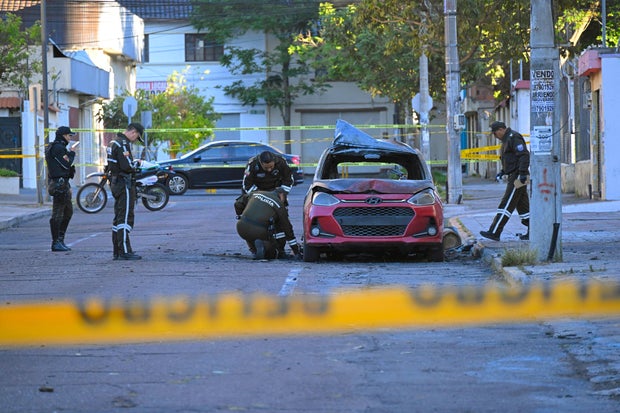
一 | Ecuador was rocked by a series of car bombings and the hostage-taking of more than 50 law enforcement officers inside various prisons Thursday, just weeks after the country was shaken by the assassination of a presidential candidate. Ecuador's National Police reported no injuries resulting from the four explosions in Quito, the capital, and in a province that borders Peru, while Interior Minister Juan Zapata said none of the law enforcement officers taken hostage in six different prisons had been injured.Authorities said the brazen actions were the response of criminal groups to the relocation of various inmates and other measures taken by the country's corrections system. The crimes happened three weeks after the slaying of presidential candidate Fernando Villavicencio.Policemen inspect the wreckage of a car after it exploded in Quito on August 31, 2023. A car bomb exploded in a commercial area of Ecuador's capital without causing casualties, police said, as the country experiences an increase in violence linked to drug trafficking. RODRIGO BUENDIA/AFP via Getty The corrections system, known as the National Service for Attention to Persons Deprived of Liberty, has in recent years lost control of large prisons, which have been the site of violent riots resulting in dozens of deaths. It has taken to transferring inmates to manage gang-related disputes. In Quito, the first bomb went off Wednesday night in an area where an office of the country's corrections system was previously located. The second explosion in the capital happened early Thursday outside the agency's current base.Ecuador National Police Gen. Pablo Ramírez, the national director of anti-drug investigations, told reporters on Thursday that police found gas cylinders, fuel, fuses and blocks of dynamite among the debris of the crime scenes in Quito, where the first vehicle to explode was a small car and the second was a pickup truck.
Authorities said gas tanks were used in the explosions in the El Oro communities of Casacay and Bella India.The fire department in the city of Cuenca, where one of the prisons in which law enforcement officers are being held hostage is located, reported that an explosive device went off Thursday night. The department did not provide additional details beyond saying the explosion damaged a car.Zapata said seven of prison hostages are police officers and the rest are prison guards. In a video shared on social media, which Zapata identified as authentic, a police officer who identifies himself as Lt. Alonso Quintana asks authorities "not to make decisions that violate the rights of persons deprived of their liberty." He can be seen surrounded by a group of police and corrections officers and says that about 30 people are being held by the inmates.Ecuadorian authorities attribute the country's spike in violence over the past three years to a power vacuum triggered by the killing in 2020 of Jorge Zambrano, alias "Rasquiña" or "JL," the leader of the local Los Choneros gang. Members carry out contract killings, run extortion operations, move and sell drugs, and rule prisons.
Los Choneros and similar groups linked to Mexican and Colombian cartels are fighting over drug-trafficking routes and control of territory, including within detention facilities, where at least 400 inmates have died since 2021.Villavicencio, the presidential candidate, had a famously tough stance on organized crime and corruption. He was killed Aug. 9 at the end of a political rally in Quito despite having a security detail that included police and bodyguards.He had accused Los Choneros and its imprisoned current leader Adolfo Macías, alias "Fito," whom he linked to Mexico's Sinaloa cartel, of threatening him and his campaign team days before the assassination.Ecuador's Security Secretary, Wagner Bravo, told FMundo radio station that six prisoners who were relocated may have been involved in Villavicencio's slaying.The mayor of Quito, Pabel Muñoz, told the Teleamazonas television station that he was hoping "for justice to act quickly, honestly and forcefully.""We are not going to give up. May peace, calm and security prevail among the citizens," Muñoz said.The country's National Police tallied 3,568 violent deaths in the first six months of this year, far more than the 2,042 reported during the same period in 2022. That year ended with 4,600 violent deaths, the country's highest in history and double the total in 2021.
The port city of Guayaquil has been the epicenter of violence, but Esmeraldas, a Pacific coastal city, is also considered one of the country's most dangerous. There, six government vehicles were set on fire earlier this week, according to authorities.
。 Ambuj Sonal, Associate Partner at Link Legal, a firm tracking mergers and acquisitions (M&A) and joint ventures, among others, spoke with Sputnik about cross-border investments in the era of growing uncertainty and the impact this will have on M&A activity in 2022 and beyond.,Sputnik: In the past two years, many restrictions have been imposed on foreign investments globally, mainly for reasons of national security. What effect have such regulatory changes had on cross-border mergers and acquisitions?,Ambuj: The primary reasons for implementing such additional scrutiny were to control the misuse of the uncertain situation and opportunistic investment behavior. Indeed, these restrictions affected cross-border deals globally in early 2020. For example, the European Commission Report on foreign investment flows [released in November 2021] suggested that foreign direct investment (FDI) flow to European countries declined by approximately 71 percent during the time of COVID.,Although these economies had amended regulations to protect their domestic companies from 'corporate raiders', this deterred foreign investors and caused a substantial decline in inbound M&A deals.,Having said that, the global cross-border M&A activity showed huge improvements in the second half of 2020, when most of the countries had started vaccination and adopted other measures to control the pandemic.,Reports show that from the second half of 2020, the volume of global deals increased by approximately 29 percent, and deal values soared by roughly 156 percent, indicating that cross-border M&A deals enjoyed a quicker recovery from COVID.,Sputnik: India has also amended foreign investment rules, explicitly targeting countries with which it shares land borders. How has it affected M&A activity and overall foreign investment flow, primarily from China?,Ambuj: The Indian government, in Press Note 3 (PN3) in April 2020, decreed that all investments from entities (direct or indirect) with which India shares a land border, would have to be made under the 'approval route' and would need security clearance.,PN3 also covered investments where beneficial ownership belonged to China, Taiwan, Hong Kong and Macau. Initially, investors from these nations approached the Indian Government for approval. However, the government was silent about these approvals until the first year of PN3.,According to data disclosed under a recent application filed under the Right to Information Act, the Department of Promotion of Industry and Internal Trade (DPIIT) has revealed that it received 382 FDI proposals from Chinese entities after PN3, of which 80 proposals have been approved.,The DPIIT made the commitment that appropriate due diligence and FDI approvals from Chinese entities would be scrutinized on a case-by-case basis. Before PN3, Chinese firms were actively investing in technology and e-commerce businesses in India, particularly in start-ups.,Up to 2019, India received foreign investments of approximately $3.4Bln from China and Hong Kong. However, post PN3, the total investment from China and Hong Kong has declined to $952Mln or 72 percent.,Having said that, despite COVID-19 and a huge drop in Chinese investments, India has received the highest annual FDI ($83.57Bln) in the 2021-22 financial year, and has emerged as a preferred investment destination.,The steps taken by the Indian government during the past few years have affected the increasing volumes of inbound FDI, which has led to record levels.,Sputnik: The geopolitical scenario has undergone tectonic changes because of tensions between China and the US, and the Russia-Ukraine conflict. Decoupling is a new buzzword that many say is part of de-globalization. How is this affecting mergers and acquisitions globally, especially in India?,Ambuj: 'Decoupling' refers to a situation where another country replaces a particular country in a global and extended supply chain. 'De-globalization' would constitute a step beyond 'decoupling' where activities that are performed offshore are brought back home completely.,Tensions between the US and China have caused a major drop in cross-border M&A deals for these two countries (an almost 95 percent drop from 2016 to 2020) primarily because of geopolitical, trade, and tariff uncertainties.,On the other hand, global M&A deals were badly hit because of the Russia-Ukraine conflict. According to data provided by Reuters, the Russia-Ukraine conflict caused the value of global M&A activities to plunge 29 percent in the first quarter of 2022.,The geopolitical scenario will most probably result in a complex and disrupted global supply chain. The present conflicts such as between US and China, and Russia and Ukraine have given rise to debate about whether we are heading towards 'decoupling', which might slowly lead to 'de-globalization'.,Decoupling and de-globalization will affect the global economy adversely and could result in long-standing inflation.,So far as India is concerned, the geopolitical situation has caused unexpected price rises, disrupted supply chains, and introduced other uncertainties because of blocked inventory. This has affected major sectors such as textiles, plastics, steel, pharma, Compressed Natural Gas (CNG), etc.,Although such geopolitical situations have majorly affected M&A activity in Asia, investments in India might see a rise. Mostly, the manufacturing sector could benefit, considering how easy it is to do business and the cost-effective labor in the Indian market.,Other European countries are already considering shifting their manufacturing facilities from China to India. This is a result of the Indian government's efforts to boost foreign investments, which has made India a preferred investment destination.,Sputnik: Despite unprecedented sanctions by the West, most Asian countries, including India, have carved out a space for themselves in this crisis and are maximizing their geopolitical leverage without limiting economic opportunities. Given this backdrop, do you think Asian countries will outpace their global peers in the M&A sector?,Ambuj: India has strong business relationships with Russia, especially in the defense, oil and gas, and automotive sectors.,Because of the sanctions imposed by the West, Russia has been isolated from global financial systems and trading. Therefore, strong support and implementation of such sanctions may not be viewed as a beneficial step.,So far as opportunities are concerned, India can be seen as an alternative supplier of manufactured exports to the West. However, the preference would be given to countries belonging to the Association of Southeast Asian Nations (ASEAN), ie Taiwan, Korea and Japan. This may result in major investments in Asian countries, which may exceed the western market's M&A activities in deal volume and size.,From a cross-border M&A point of view, India remains a preferred destination with an FDI of approximately $83.57Bln and 2,064 M&A deals in the 2021-22 financial year, which puts it in top spot globally. Mauritius and Singapore remain the top investors for India, and we can see India being comfortably placed as an attractive business nation.,Sputnik: Recently, a large number of western firms have announced their intention to leave the Russian market. Has this created space for Indian firms to buy assets or to invest in Russia?,Ambuj: Yes. Judging from the silence of the Indian government on the subject of sanctions, Indian firms are keen to capitalize on the geopolitical conflict as an opportunity to invest and gain a share of the Russian market. Opportunities are available mainly in industries serving the pharmaceutical, oil and gas, and manufacturing sectors.,Furthermore, since big global companies such as Apple, fast retail and Ikea have shut or kept their operations in Russia on hold, mid-size Indian companies in the retail and fast-moving Consumer Goods (FMCG) sectors are also interested in doing business in India.,Additionally, since supply chains between Russia and -European countries are blocked, Indian suppliers are looking to initiate strong trade relations by offering undisrupted supply to Russia.,Sputnik: Reports claim that Russian businesses and other big players have been looking for ways to invest their money in Asia. What kind of investment opportunities does the Indian market offer them?,Ambuj: Unlike the UK, India does not offer any scheme like a 'Golden Visa' for Russian businessmen who can trade for their residential status in lieu of multi-million investments in the country. However, investment opportunities in India remain plentiful and attractive. As India's Prime Minister said at the World Economic Forum in Davos this year: "This is the best time to invest in India.!,Over the years, the Indo-Russian bilateral relationship has developed into a comprehensive partnership that includes cooperation in several high-technology sectors.,India and Russia have projected that bilateral trade will be worth $30Bln by 2025. This will boost the India-Russia business relationship, and many opportunities await Russian investors in India.,The key areas for Russian investments to focus on in India are telecommunications, automobiles, industrial services, oil and gas, and medical/surgical appliances.,Want to know more? Check out our Koo & Telegram accounts!,Koo: https://www.kooapp.com/profile/sputniknews,Sputnik India: https://t.me/sputniknewsindia。
Current article:http://d9n.cuancuguanzhongnieqinyazhun.cyou/buoi/20260826/7510.html